Check it on a calculator
Open 6÷2(1+2) in the scientific calculator. It gives 9 by default, and 1 if you switch Settings → Implicit multiplication to Higher priority. To get the same answer on every calculator, type (6÷2)(1+2) for 9 or 6÷(2(1+2)) for 1.
How to solve 6÷2(1+2) step by step
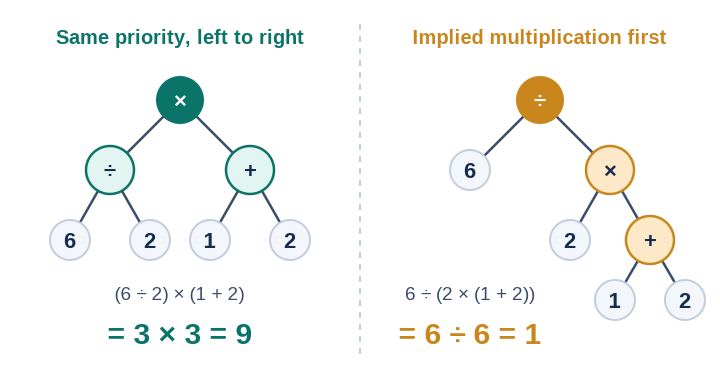
Both readings start the same way: the parentheses come first, so 1 + 2 = 3 and the expression becomes 6 ÷ 2(3). They part company on the next step, depending on whether the 2 written against the parenthesis is an ordinary multiplication or part of a single term.
Parentheses first
, so becomes .
Reading 1: left to right (answer 9)
Treat 2(3) as 2 × 3. Division and multiplication have the same priority, so work from left to right: , then .
Reading 2: implied multiplication first (answer 1)
Treat 2(3) as one quantity and multiply it out first: , then .
The famous variant 8 ÷ 2(2 + 2) works the same way: 16 under the left-to-right reading, (8 ÷ 2) × 4, and 1 if 2(2 + 2) is grouped first, 8 ÷ 8. The New York Times ran a piece by the mathematician Steven Strogatz on it in 2019, after it went viral.
What is the order of operations?
The order of operations is the agreed sequence for working out an expression that has more than one operation in it. In the United States it is taught as PEMDAS, and in the UK, India, Australia and many other countries as BODMAS or BIDMAS:
- Parentheses (brackets) first, innermost first.
- Exponents: powers and roots.
- Multiplication and division, with equal priority, from left to right.
- Addition and subtraction, with equal priority, from left to right.
| Step | PEMDAS (US) | BODMAS (UK, India) | BIDMAS (UK) |
|---|---|---|---|
| 1 | Parentheses | Brackets | Brackets |
| 2 | Exponents | Orders | Indices |
| 3 | Multiplication and Division, left to right | Division and Multiplication, left to right | Division and Multiplication, left to right |
| 4 | Addition and Subtraction, left to right | Addition and Subtraction, left to right | Addition and Subtraction, left to right |
So do you multiply or divide first? Neither: the two share a level and are worked from left to right. The M before D in PEMDAS (and the D before M in BODMAS) is only there to make a pronounceable word. That is why 12 ÷ 3 × 2 is 4 × 2 = 8, not 12 ÷ 6 = 2, and why PEMDAS and BODMAS always give the same result.
Why 6÷2(1+2) has two answers: implied multiplication
PEMDAS covers ×, ÷, + and −, but it says nothing about implied multiplication (also called implicit multiplication or multiplication by juxtaposition): a number written directly against a parenthesis or a letter, as in 2(1 + 2) or 2x. Is 2(1 + 2) just a shorter way of writing 2 × (1 + 2), or is it a single unit, like a term in algebra? That one question produces the two answers.
The left-to-right reading treats it as an ordinary ×. That is the strictly mechanical reading of PEMDAS, and it is what programming languages and spreadsheets do, for a simple reason: they have no implied multiplication at all. You must type 6/2*(1+2), and they return 9.
The other reading treats a product written by juxtaposition as one quantity. You have probably used this convention without noticing. Many readers take to mean rather than , and to mean ; much of the published literature in algebra and physics is written this way. Writing for relies on the same instinct that the 2 and the x belong together.
Is PEMDAS actually correct?
Yes, for what it covers. PEMDAS is a convention rather than a law of mathematics, and for expressions with explicit operators everyone agrees on it. Its gap is implied multiplication, and that gap is old. In 1917, N. J. Lennes pointed out in The American Mathematical Monthly that algebra textbooks stated a left-to-right rule for × and ÷ but that, in practice, multiplications were usually done first. A century later the two conventions still coexist, which is why a well-written expression never leaves the reader to choose between them.
What calculators and apps give for 6÷2(1+2)
A calculator that accepts implied multiplication has to pick one rule, and they do not all pick the same one. Software without implied multiplication sidesteps the question by refusing the input. The rows marked Tested were run by us on November 14, 2026; the handheld rows are as documented in Wikipedia’s order of operations article, which shows photos of both screens.
| Calculator or app | 6÷2(1+2) | 8÷2(2+2) | Source |
|---|---|---|---|
| ScientifiCalc, default setting | 9 | 16 | Tested |
| ScientifiCalc, Implicit multiplication: Higher priority | 1 | 1 | Tested |
| TI-83 Plus | 9 | not documented | Reported |
| Casio fx-82MS | 1 | not documented | Reported |
Python 3: 6/2(1+2) | error: not callable | error | Tested |
Python 3 and JavaScript: 6/2*(1+2) | 9 | 16 | Tested |
JavaScript (Node.js): 6/2(1+2) | error: 2 is not a function | error | Tested |
bc (Unix calculator): 6/2*(1+2) | 9 | 16 | Tested |
Manufacturers have changed the rule between product generations, too: the same Wikipedia article notes that the TI-82 read as , while the TI-83 and later Texas Instruments models read it as . Phone and computer calculator apps vary as well, so if you rely on a particular device, run the two-line test below rather than assume.
Other expressions calculators disagree on
Calculators can also differ on neighboring questions: whether a leading minus sign applies before or after a power, and how a chain of powers groups. Here is how ScientifiCalc reads some common cases:
| You type | Read as | Result |
|---|---|---|
6÷2(1+2) | (6 ÷ 2) × (1 + 2) by default | 9, or 1 with the Higher priority setting |
12÷3×2 | (12 ÷ 3) × 2: left to right | 8 under either setting |
-3^2 | −(3²): the power comes first | −9 |
(-3)^2 | (−3)² | 9 |
2^3^2 | 2^(3²): powers group from the right | 512 |
1/2x with x = 4 | (1/2) × x by default | 2, or 0.125 with Higher priority |
sin 2x | sin(2x) | the sine of 2x |
Spreadsheets are a useful warning. Microsoft’s documentation for Excel puts negation (as in −1) above exponentiation and works operators of equal precedence from left to right, so =-3^2 returns 9 and =2^3^2 returns 64, where standard notation gives −9 and 512. The Unix calculator bc also returns 9 for -3^2; we tested it. In standard mathematical notation, and in ScientifiCalc, : write when you mean 9.
Using ScientifiCalc as an order of operations calculator
The scientific calculator works as a PEMDAS or BODMAS calculator: it applies the standard order to everything you type, and it lets you choose how implied multiplication is read. In Settings, the Implicit multiplication option has two values:
- Same priority as × and ÷ (the default): 6 ÷ 2(1 + 2) = 9. Implied and explicit multiplication behave identically, which matches programming languages and the mechanical reading of PEMDAS.
- Higher priority: 6 ÷ 2(1 + 2) = 1. A product such as 2(1 + 2) or 2x is grouped first, which matches the textbook habit of reading as .
The setting is saved in your browser, so it stays the same on your next visit. It changes only how implied products are grouped. An expression with an explicit operator, such as 6/2*(1+2), is 9 under either setting. To see the order of operations worked one step at a time, enter the expression in the math solver, which shows how it read your input as formatted math before it simplifies.
How to write expressions nobody can misread
The real fix is to remove the ambiguity, so the answer no longer depends on anyone’s convention:
- Add parentheses for the grouping you mean. Type
(6/2)(1+2)if you mean 9 and6/(2(1+2))if you mean 1. - Put whole numerators and denominators in parentheses. Type
(a + b)/(c + d), nota + b/c + d, and1/(2x)when you mean one over 2x. - Prefer a fraction bar in written work. and cannot be confused, whereas the ÷ sign (the obelus) hides the grouping. ISO 80000-2, the international standard for mathematical notation, drops the ÷ sign altogether in favor of a slash or a fraction bar.
- Do not chain slashes without parentheses. By the left-to-right rule
a/b/cmeans (a/b)/c, but readers may guess otherwise. The international rules for writing SI units make the same point: m/s² is fine, but m/s/s should not be written without parentheses. - Wrap negative numbers before powers. Type
(-3)^2when you mean 9. - Check how the input was read. The math solver renders your input as formatted math, so you can confirm the grouping before trusting the answer.
A two-line test for any calculator
To find out which conventions a calculator uses, enter 6÷2(1+2) a result of 9 means implied multiplication has the same priority as division, and 1 means it binds tighter. Then enter -3^2: −9 is the standard reading, while 9 means the minus sign is applied before the power. You can compare against ScientifiCalc’s answers for 6÷2(1+2) and -3^2. Knowing these two answers prevents most surprises, whether you are moving between a handheld, a phone and a spreadsheet, or checking a classmate’s result.